
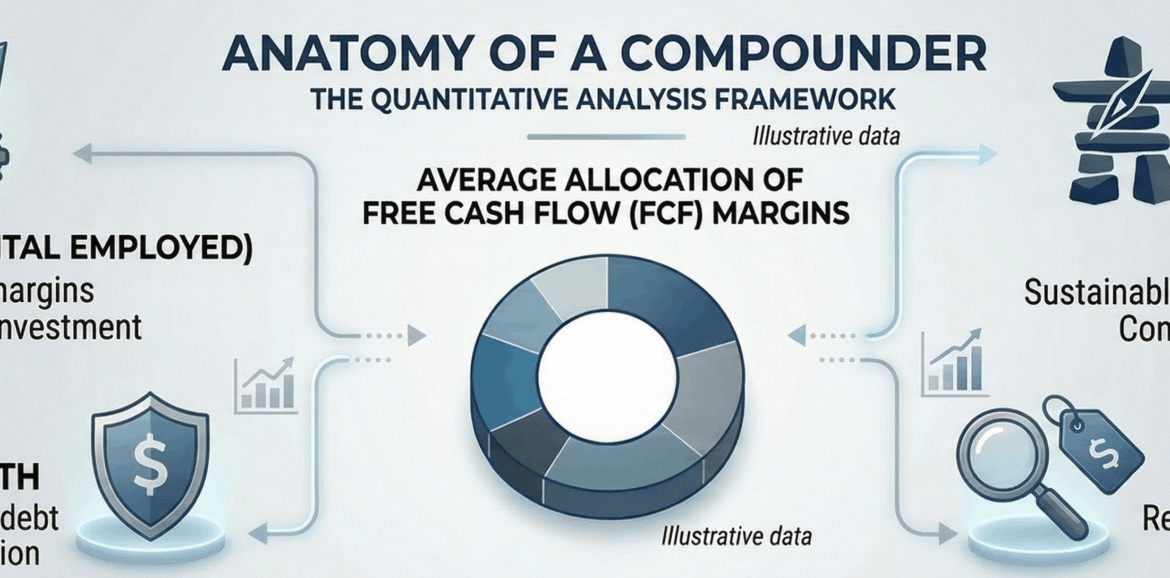
Fundamental investing requires strict discipline and a deep understanding of the mechanisms that create true long-term wealth. At Nivence Capital Research, our approach stands apart from media noise and promises of ephemeral growth to focus on identifying companies with inelastic foundations. We target these compounding machines capable of generating and reinvesting their cash flows at exceptional rates of return on a sustained basis.
To systematize this research within a stock market where thousands of companies compete to attract capital, we have designed a rigorous quantitative screening tool. This screener is based on nine highly demanding criteria that work in synergy. This research document aims to deconstruct this model, explain its underlying calculations, its mathematical justifications, and its benefits for the investor focused on value and long-term capital compounding.
1: ROCE TTM >10%
2: ROCE 5-Year Ave. >10%
3: Revenue 5-Year CAGR >5%
4: Levered FCF 5-Year CAGR >5%
5: Net Debt/EBITDA <3 6: 5-Year Shares Out. Growth < 2% 7: FCF Margin 5-Year Ave >5%
8: Dividend per share 5-year CAGR >5%
9: FCF Yield >5%
Value Creation Through Return on Capital Employed
Criterion 1: Trailing Twelve Months Return on Capital Employed greater than 10%.
Criterion 2: 5-Year Average Return on Capital Employed greater than 10%.
Return on Capital Employed, commonly known as ROCE, is the definitive metric for the quality of a business model. Unlike return on equity, which can be artificially inflated by massive debt, ROCE evaluates the profitability of the entire capital engaged in operations. The calculation is performed by dividing the operating profit, meaning earnings before interest and taxes, by the capital employed. The latter is obtained by subtracting current liabilities from the company’s total assets.
Requiring a 10% threshold is no coincidence. Every company is subject to a weighted average cost of capital, which represents the return demanded by its creditors and shareholders in exchange for the risk assumed. For a mature North American company, this financing cost typically sits between 7% and 9%. A company that posts a 5% ROCE may report excellent accounting profits, but it is technically destroying economic value since it poorly compensates the money provided to it.
By imposing a 10% threshold on the current year as well as a historical five-year average, Nivence Capital Research immediately eliminates capital destroyers. This temporal filter protects the investor against statistical anomalies and short-term economic cycles that temporarily flatter balance sheets. A company capable of maintaining a double-digit ROCE over half a decade demonstrates the existence of durable competitive advantages, whether it be high switching costs for its customers, superior logistical efficiency, or a brand endowed with strong pricing power.
Validation of Healthy Organic Growth
Criterion 3: 5-Year Revenue Compound Annual Growth Rate greater than 5%.
Criterion 4: 5-Year Levered Free Cash Flow Compound Annual Growth Rate greater than 5%.
The use of the compound annual growth rate is essential to evaluate a company’s true trajectory. This mathematical calculation smoothes out sharp annual variations and determines the constant rate at which an investment would have needed to grow to move from its initial value to its final value.
We set the revenue growth floor at 5%. This highly pragmatic threshold ensures that the company grows at a rate logically superior to average long-term inflation. Lower growth would clearly indicate a company in a phase of real decline or losing market share to its sector competitors.
However, revenue growth is useless if it does not materialize into tangible liquidity. This is why the fourth criterion requires equivalent growth in free cash flow. This flow represents the actual cash that remains available to the owners after paying interest on debt, taxes, and the capital expenditures necessary to maintain the infrastructure. When a company sees its sales increase but its cash flows stagnate, it is generally experiencing severe margin compression or requires increasingly heavy investments simply to maintain its position. The symmetrical 5% alignment on these two metrics attests to healthy, structural, and entirely self-financed expansion.
Financial Resilience in the Face of Macroeconomic Adversity
Criterion 5: Net Debt to EBITDA ratio less than 3.
Balance sheet strength is the investor’s only true life insurance. To measure it objectively, we use the Net Debt to EBITDA ratio. Net debt is calculated by adding all of the company’s short- and long-term borrowings and subtracting available cash and cash equivalents. The denominator, EBITDA, represents the gross operating cash flow before tax and financial obligations eat into profits. This quotient precisely indicates how many years of current operating profit would be required to repay all bank and bond debts.
A threshold below 3 represents Nivence Capital Research’s strict dividing line between an optimized capital structure and a high-risk balance sheet. Companies that exceed this leverage ratio become extremely captive to their creditors. When debt refinancing becomes expensive during periods of global monetary tightening, the majority of cash flows are diverted toward debt service at the expense of core operations and shareholder returns. By applying this prudent limit, we ensure that the company retains its strategic independence and its capacity to acquire weakened competitors during future recessions.
Respect for the Shareholder and Capital Structure Integrity
Criterion 6: 5-Year Shares Outstanding Growth less than 2%.
Criterion 7: 5-Year Dividend Per Share Compound Annual Growth Rate greater than 5%.
Global wealth creation at the corporate level must necessarily translate into proportional wealth creation at the level of each individual share. Outstanding share growth is measured by comparing the total count of shares at the beginning and end of the sixty-month period. A company that massively issues new shares to finance overly expensive acquisitions or to compensate its executives directly dilutes your financial stake. It is the mathematical equivalent of watching your slices of the pie shrink endlessly. A restrictive 2% cap allows us to absorb basic employee compensation programs while categorically rejecting companies that finance their ambitions on the back of the retail shareholder.
In perfect complementarity with this protection against dilution, we require dividend per share growth of more than 5%. This criterion is absolutely not intended to build a high-yield immediate dividend portfolio, but rather to validate management’s strict financial discipline. Distribution growth that aligns mathematically with the required growth of available cash flows ensures that the company’s payout ratio will always remain sustainable. This demonstrates that management has enough confidence in the visibility of its future liquidity to publicly commit to systematically returning more capital to owners, while retaining the necessary means to finance internal innovation.
Operational Efficiency and Quality of Cash Conversion
Criterion 8: 5-Year Average Free Cash Flow Margin greater than 5%.
The free cash flow margin is obtained by dividing the actual cash collected by the company’s total revenue. It illustrates the fundamental operational efficiency of the organization. For every dollar of product sold to a customer, what exact proportion actually ends up in the company’s coffers, free of any operational obligation?
Requiring a historical floor margin of 5% is a vital operational safety measure. Companies operating with microscopic margins, as is regularly the case in certain big-box retail or low-end commodity manufacturing sectors, have virtually no margin of error. A slight inflation in freight costs, a temporary spike in energy prices, or a minimal slowdown in sales is enough to turn a supposedly profitable year into a disastrous deficit. Conversely, by imposing this level of conversion efficiency, we exclusively select business models that possess the necessary financial cushion to absorb various inflationary shocks without jeopardizing their existence.
The Pragmatic Discipline of Valuation
Criterion 9: Current Free Cash Flow Yield greater than 5%.
The free cash flow yield is the most honest valuation criterion at our disposal to judge how expensive a stock is. It is calculated by dividing the free cash flow per share by the current price demanded on the stock exchange, or equivalently, by dividing the company’s total free liquidity by its total market capitalization.
This ninth and final parameter acts as an uncompromising gatekeeper to Nivence Capital Research portfolios. It ensures that the investor gets a tangible return on investment from the very first day of acquisition. Requiring an initial cash yield of 5%, combined with the robust growth we previously validated, creates a true Benjamin Graham-style margin of safety. This valuation filter automatically screens out trendy stocks whose valuation depends exclusively on hyper-optimistic revenue forecasts fifteen years down the line. We categorically refuse to pay top dollar for mere distant promises. We buy existing cash flows that are already growing, at a rational price that protects capital against inevitable multiple contractions in the stock market.
The Ecosystem of the Quantitative Research Screener
The most powerful aspect of this research framework does not lie in the strictness of any specific mathematical criterion, but rather in the way all nine parameters intertwine to block the passage of value traps.
A cyclical natural resource company might post a high cash margin during this particular year, but it will fail miserably at the test of high and consistent return on capital employed over a full five-year cycle. A promising startup will brilliantly meet the criteria for explosive revenue growth, but its inability to generate an initial 5% free cash flow yield will disqualify it on the spot. Finally, a mature commercial business in a phase of slow decline might look very cheap and offer a seemingly attractive dividend yield, but its absolute lack of genuine organic growth will eliminate it from our radars.
This screening process built by Nivence Capital Research is above all a work of subtraction and rejection of mediocrity. The very rare companies that achieve the feat of passing through these nine gates inevitably possess the intrinsic attributes of formidable wealth creators. They are endowed with a protected competitive advantage, an ironclad balance sheet, highly disciplined corporate management in their capital allocation, and a current market price that allows the rational investor to reap the rewards over time.
It is only upon these logical foundations that investment methods destined to prosper across decades are built.
Legal Disclaimer and Limitation of Liability
This document is published by Nivence Capital Research for strictly informational and educational purposes. Under no circumstances does it constitute an offer, a solicitation, or a recommendation to buy or sell financial securities. The content provided should not be construed as personalized investment, legal, tax, or accounting advice.
Investing in the stock market involves substantial risks, including the total loss of invested capital. The past performance of the mentioned companies or the quantitative selection strategies described, including the use of any research screener, in no way guarantees future performance. Market dynamics, economic cycles, and macroeconomic conditions are unpredictable and can rapidly invalidate any investment hypothesis.
Although the information, calculations, and data presented in this document come from sources we deem reliable, Nivence Capital Research makes no warranty, explicit or implied, regarding their accuracy, completeness, or relevance. The analysis models discussed may contain errors, omissions, or simplifications that could skew the results. The opinions expressed reflect the author’s judgment as of the publication date and are subject to change without notice.
The author of this text is not a registered financial advisor or an accredited portfolio manager with regulatory authorities. Every investor is unique. Before executing any transaction in your various brokerage accounts, whether registered or taxable, you bear the sole responsibility for conducting your own thorough research. It is strongly recommended that you consult a qualified financial professional who can validate the suitability of these concepts with your personal financial situation, return objectives, and risk tolerance.
Finally, please note that the author, Nivence Capital Research, or its affiliates may hold, directly or indirectly, long or short positions in the securities that could be identified by the methods described in this document, and they reserve the right to modify these market positions at any time, without any obligation of prior or subsequent public disclosure.